
Passport stamps are disappearing - here's how to keep the ones you have
Europe switched off the ink in April 2026. The border stamp is turning into a keepsake instead of a routine - which is exactly why it's worth saving the ones you've got.
For decades, the thud of a rubber stamp hitting a passport page was the unofficial soundtrack of arriving somewhere new. That sound is going quiet - and faster than most people realise.
On 10 April 2026, the European Union’s Entry/Exit System (EES) became fully operational, and with it the manual stamping of passports for non-EU travellers on short stays was abolished across the Schengen area. Instead of ink, the border now records your entries and exits as a digital file tied to your biometrics. The system had been rolling out gradually since 12 October 2025; from April, the stamp pad is officially retired.
It doesn’t stop there. The EU’s ETIAS travel authorisation - a visa-waiver registration for visitors from countries like the US, UK, Canada, Australia and Brazil - is expected to come online in the last quarter of 2026. The direction is unmistakable: borders are going digital, and the inked passport stamp is becoming a souvenir rather than a procedure.
Which countries still stamp passports?
Schengen switched the ink off, but the rest of the world did not move together. Some countries stopped entirely, some only stopped at the e-gate, and a few still reach for the stamp pad. We keep a sourced status for each one:
| Country | Passport stamp |
|---|---|
| Brazil | Still stamps |
| the United States | Phasing it out |
| the United Kingdom | Not at the e-gate |
| Japan | Not at the e-gate |
| Canada | Not at the e-gate |
| Mexico | Phasing it out |
| France | Stopped |
Every country links to its own page with the sources behind the status. The full record lives at which countries still stamp passports.
Why this matters even if you love the convenience
Digital borders are genuinely faster, and nobody’s going to miss queueing while an officer hunts for a blank page. But there’s a quiet casualty here. That messy collage of passport stamps was the only physical record most of us kept of where we’d actually been. No app, no boarding pass, no photo dump - just ink, a date, and a place.
Once the stamping stops, two things happen. New trips leave no mark at all. And the stamps you already have start their slow fade - thermal and rubber-stamp ink doesn’t last forever, and a passport gets renewed every ten years and tossed in a drawer (or worse).
So the window to keep a record of the countries you’ve visited is closing on the analog side and opening on the digital one. That’s the whole reason Stamp Hunt exists.
How to archive the stamps you still have
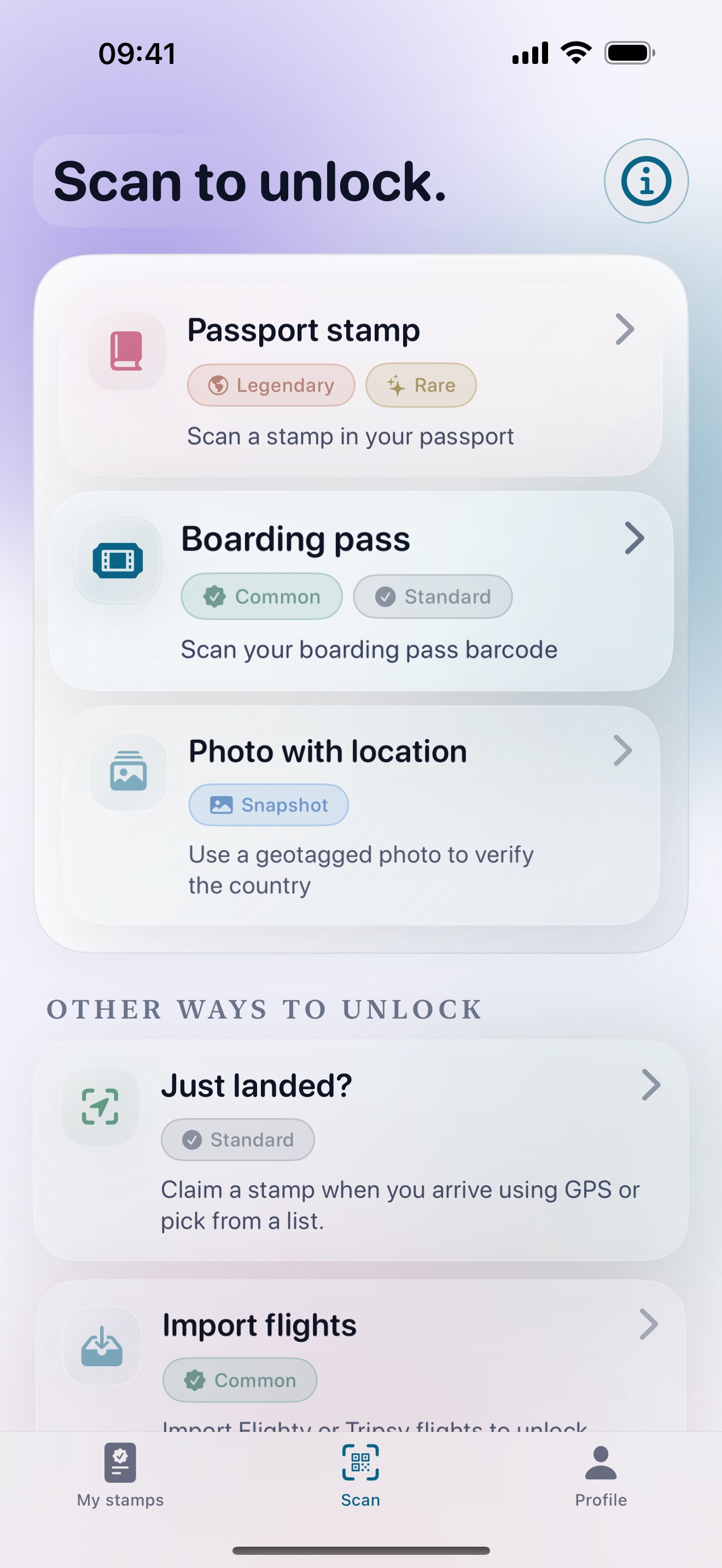
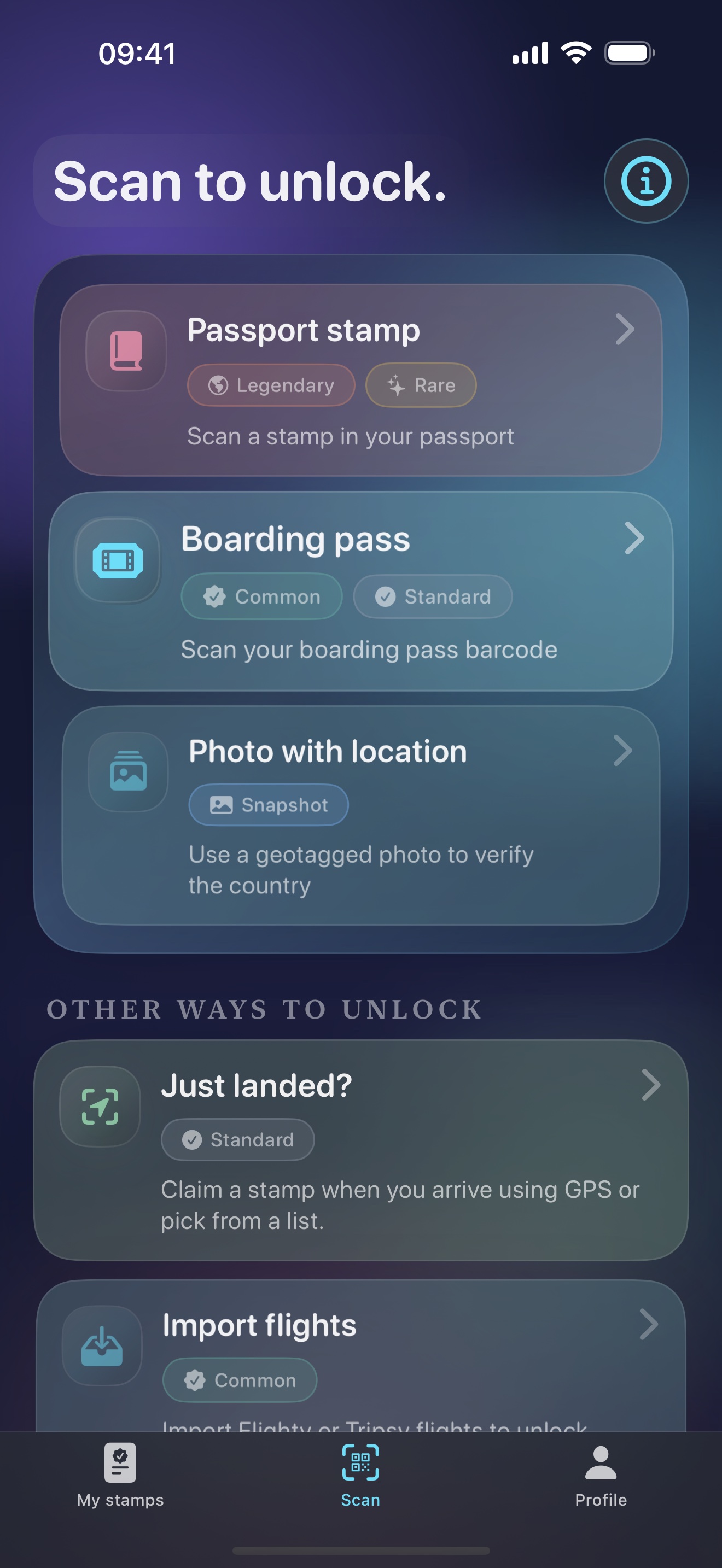
Stamp Hunt is a private, on-device archive for exactly this moment. The flow is deliberately quick:
- Scan the mark. Open the camera, frame an inked stamp on the page, and the app reads the country. The photo never leaves your iPhone.
- Pick your proof. Every country can sit at one of five proof tiers - from a one-tap manual claim up to a passport-scan-plus-GPS Legendary. You log the level of evidence you actually have, and you can strengthen it later.
- Watch the map fill in. Each stamp lands on a private world map you browse by country, year, or tier. It’s an archive, not a feed - there’s no profile to maintain and no followers to perform for.
If you’ve got an old passport in a drawer, this is the afternoon to dig it out. Those pages are now a finite collection, and scanning your passport stamps before the ink fades is the closest thing to preserving them.
Once a few stamps are in, the obvious next question is how many countries that actually adds up to. Our guide on counting the countries you’ve visited breaks down the 195-country scoreboard and the five proof tiers behind each one.
“My passport wasn’t stamped leaving France” - what that means
Nothing went wrong. This is the most common version of the question, and the short answer is that the border did exactly what it was rebuilt to do.
France completed the switch across all of its borders in the week after 10 April 2026. If you left a French airport and came away with no stamp and no biometric check, that is the system behaving as designed - EES already holds your entry, and an exit is matched against it electronically. The absence of a stamp is not the absence of a record.
But something does change: you can no longer count stamps to work out your own 90-in-180 allowance. So verify it another way.
- Check your remaining days on the EU’s official travel portal, which now exposes a calculator tied to the EES rules.
- Ask at the border. You have the right to ask a border officer how many days you have left, and they can read it off the system.
- Keep your own dated proof - boarding passes, tickets, bookings. The database is the authority now, but it is also three months old, and reporting on the rollout says records may not be fully accurate while the system beds in.
- You can request your data. EES gives travellers the right to ask what is recorded about them and to have inaccuracies corrected. For French crossings that request goes to the Direction générale des étrangers en France, or to the ministry’s data protection delegate at the Ministère de l’Intérieur.
France is one case of a much wider pattern, and the pattern is not uniform - some countries stopped entirely, some only stopped at the e-gate, and a few still reach for the ink. We keep a sourced, country-by-country breakdown at which countries still stamp passports.
Going somewhere this year? Capture the rare ones
Plenty of countries outside Schengen still stamp - and now those stamps are the rare ones worth chasing. If your next trip is a domestic one, the same idea runs in Stamp Hunt Brasil, which turns flights and road-trips across all 27 Brazilian states into the same kind of private collection. Both apps share the same rule we hold across all of our apps: your data lives on your device, not on a server we control.
The border officer’s stamp is on its way out. The collection doesn’t have to go with it.
Sources
- Entry/Exit System (EES) is fully operational - European Commission, Migration and Home Affairs (10 April 2026)
- Entry/Exit System (EES) - European Commission, Migration and Home Affairs
- FAQs about EES - Travel to Europe (official EU portal)
- European Travel Information and Authorisation System (ETIAS) - Travel to Europe (official EU portal)
- EES: the new European border Entry/Exit System goes live on 10 April 2026 - France Diplomatie
- The Entry/Exit System will become fully operational on 10 April 2026 - European Commission (30 March 2026)
- Passport not stamped upon leaving France and no biometrics taken - should I be worried? - The Connexion
Frequently asked questions
Did Europe really stop stamping passports?
Yes. On 10 April 2026 the EU Entry/Exit System (EES) became fully operational, and manual passport stamping for non-EU short stays ended across the Schengen area. Entries and exits are now recorded digitally instead of with ink.
Can I still keep a record of my passport stamps?
Yes. Stamp Hunt scans the inked stamps you already have into a private archive on your iPhone, so the collection survives even after the ink fades or the passport is renewed and tossed in a drawer.
Does scanning a stamp upload the photo?
No. The app reads the country from the stamp using the camera, and the photo never leaves your device. There is no account and no server.
Is Stamp Hunt free?
It starts free for your first 10 country stamps, and a one-time purchase unlocks unlimited stamps with no subscription.