A private travel collection app: log trips without a cloud account
Private travel apps keep your movements on your own device, with no server. That is the Stamp Hunt model, built for people who do not want their life's route living in a cloud.
Private travel apps keep your movements on your own device, with no server in the middle. That is the Stamp Hunt model: there is no mandatory account, and the map of countries you have visited lives on your iPhone, not in a cloud profile that someone else controls. It is built for people who like keeping a travel record but do not want their life’s route sitting on a company’s server.
This guide explains what “private” actually means here, in concrete terms, because the word gets used loosely.
What a private travel collection app is
A travel collection app turns “places I have been” into a list, a map, and a count. A private one does that without sending the list anywhere. There is no login, no account profile, and no server-side copy of where you go. The collection is data on your phone, backed up the same way the rest of your phone is, and visible to you alone.
That is different from most travel trackers, which are built around a cloud account. Those need the cloud to sync between devices and to power social feeds, which is a fair trade if you want those features. Stamp Hunt makes the opposite choice on purpose.
How on-device logging works
Three things make Stamp Hunt private in practice, not just in marketing:
- No account. You never sign up. There is no email, no password, and no profile that ties your travels to your identity.
- On device, so it works offline. The collection is stored locally, which means you can mark a country with no connection. That matters, because being abroad is exactly when your data plan is worst.
- A photo reveals only its country. When you back a country with a geotagged photo, the app reads only the country from the photo’s EXIF location. The image itself never leaves the phone, so you are sharing a fact (“this was Portugal”), not your camera roll.
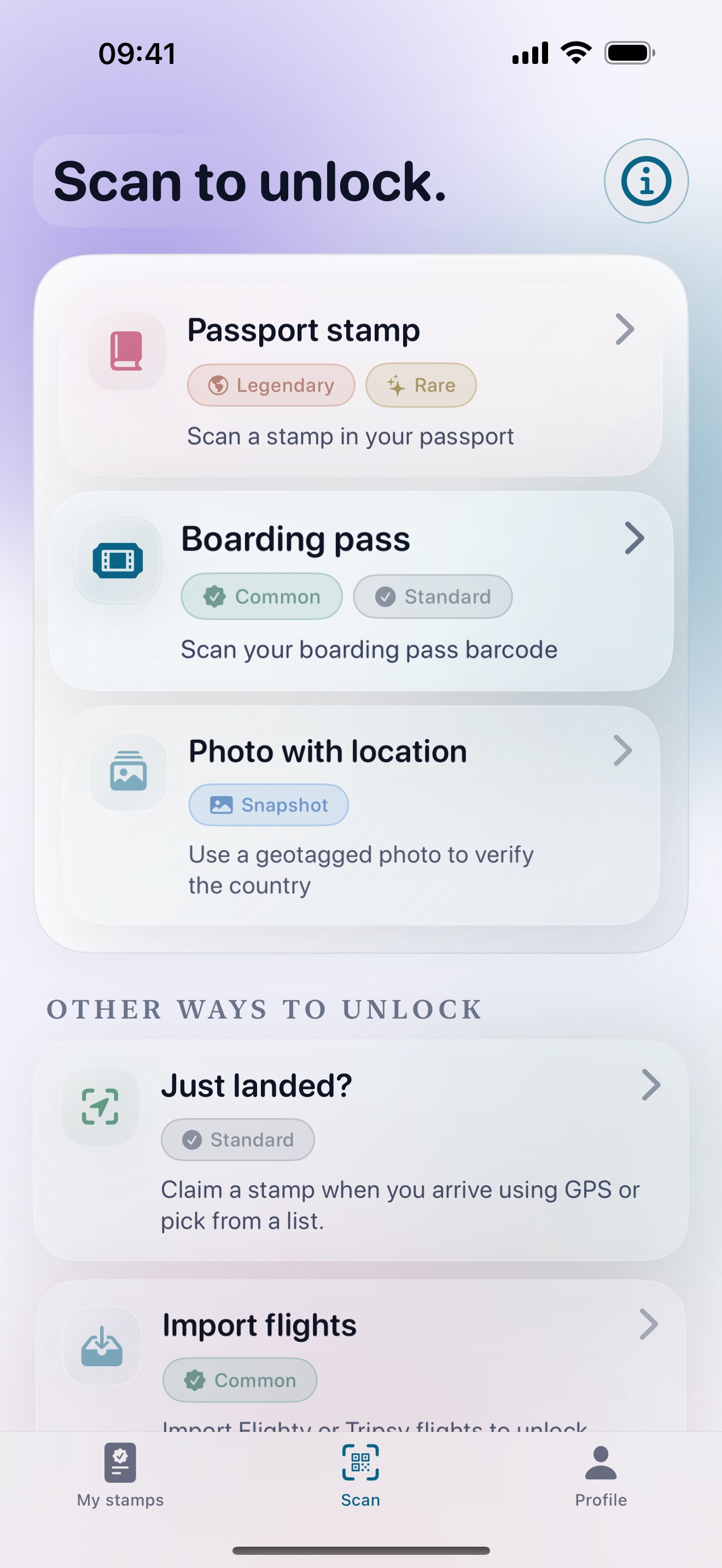
You can still prove where you went. A scanned passport stamp, a boarding pass imported from Apple Wallet, a geotagged photo, or on-the-ground GPS each back a country with real evidence, and all of it stays local.
Who this is for
If you want a social timeline of your trips, a cloud app is the better fit, honestly. But if the idea of a permanent, server-side history of your movements bothers you, a private on-device app is the point. Stamp Hunt is free on the App Store for your first 10 country stamps, with a one-time purchase to unlock the rest and no subscription.
Travelling with other people and splitting costs? You can keep that private too: FastBillSplit scans the receipt and divides the bill on the spot, so there is no shared spreadsheet to leak.
Sources
- On-device behaviour, no-account model and the EXIF country-only read as described on the Stamp Hunt homepage and in the countries-visited guide.
- Free tier and one-time “Unlimited Stamps” purchase as listed in the App Store.
Frequently asked questions
What is a private travel app?
A private travel app records where you have been on your own device instead of on a company's server. Stamp Hunt is one: there is no mandatory account and your collection stays on the iPhone, so your travel history is not part of a cloud profile that can be mined, leaked or sold.
Does Stamp Hunt need an account?
No. It works with no sign-up. You open the app and start marking countries, and nothing about you is uploaded to use it.
Does it work offline?
Yes. Because the data lives on the device, you can log a country with no connection, which is exactly when you are most likely to be abroad.
If I add a photo, does the image get uploaded?
No. When you confirm a country with a geotagged photo, Stamp Hunt reads only the country from the photo's location data. The image itself never leaves your device.